
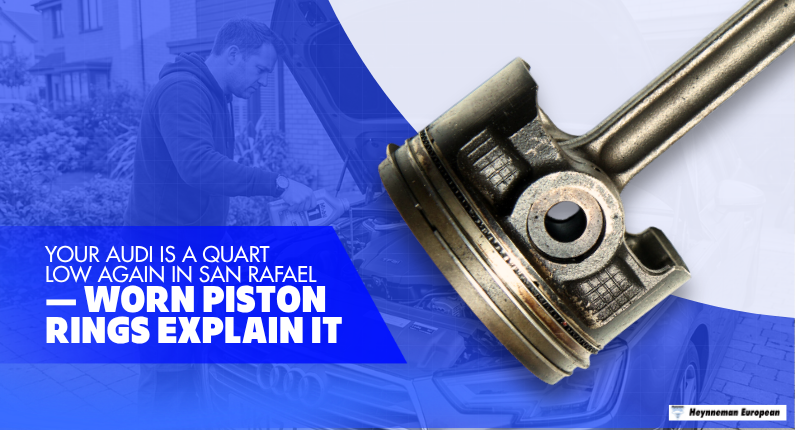
The low oil warning comes on between services. You add a quart. The driveway is dry, nothing smells like burning oil, and the last shop that looked found no leak. Frustrating. On the 2.0-liter turbo four in a lot of Audi A4, A5, A3, Q5 and TT models, the answer usually isn’t a leak at all — the engine is burning oil past worn piston rings, and it has probably been doing it for a while.
Heynneman European has worked on Audi and Volkswagen in San Rafael since 1979, and this is one of the most common complaints Marin owners bring us. It’s also one of the most commonly guessed at. Before anyone quotes you engine work, the consumption rate needs measuring properly.
Quick Summary: Key Takeaways
- Consumption is not always a leak: oil burned in the cylinders leaves no puddle and often no visible smoke.
- Which engines: the earlier 2.0T four used through roughly 2012 in the A4, A5, A3, Q5 and TT is the one owners ask about most.
- Measure before you repair: a controlled consumption test over a set mileage is how the cause gets established.
- Rings are only one suspect: the crankcase breather system, valve stem seals and the turbo seals can all contribute.
- Running low is the real damage: two quarts down is where oil pressure and bearing life start paying for it.
How the oil disappears without leaving a trace
Piston rings do two jobs — seal combustion pressure and scrape oil off the cylinder wall on the way down. When the oil control ring or its drain holes lose that ability, oil stays on the wall and burns with the fuel.
There’s no drip, because none of it ever leaves the engine as liquid. The exhaust may show a faint blue haze on a cold start or after a long idle, though modern catalytic converters hide most of it, which is exactly why owners get told nothing’s wrong for two or three years while the consumption slowly worsens. The dipstick is the honest witness here.
What counts as too much oil consumption
Every engine uses some oil. The number that matters is quarts per thousand miles, and it has to be measured rather than estimated from memory.
We do a controlled test: fill to a precise level, seal and document it, then re-measure at a set mileage with the car warm and level. A quart every 1,200 miles on a modern four-cylinder is a problem worth investigating. A quart every 4,000 is generally not. Guessing from memory of “how often I add a bottle” is how people end up paying for the wrong repair — and the difference is a documented number, not an opinion.
Rings are the headline, but check the cheaper causes first
Not every high-consumption 2.0T needs pistons. Several cheaper faults produce the identical complaint, and we rule those out before recommending anything expensive.
A stuck crankcase breather pulls oil straight into the intake tract. Hardened valve stem seals let oil down the guides. Turbo shaft seals pass oil into the charge air. Any of these will empty a sump without wetting your driveway, so the diagnostic order matters — you look at the accessible items, verify the result, and only then talk about the bottom end.
The oil you use makes a measurable difference
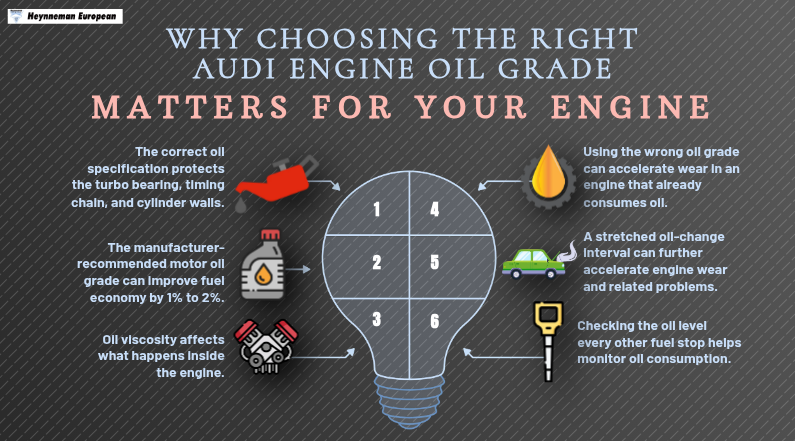
Grade matters here, and not only for consumption. The correct specification protects the turbo bearing and the timing chain as much as it protects the cylinder walls.
Using the manufacturer’s recommended grade of motor oil improves fuel economy by 1% to 2%, according to the U.S. Department of Energy — a small number that tells you something bigger about how much oil viscosity affects what happens inside an engine. On a car that already consumes oil, the wrong grade and a stretched interval accelerate the wear that caused the problem. Check the level every other fuel stop. Genuinely.
What we do about it once the cause is confirmed
We give you the real options, ranked. Sometimes it’s a breather assembly and a new interval. Sometimes it’s deeper engine work.
If the rings are the cause, the honest conversation covers the age and value of the car, how much oil you’re prepared to add, and what the repair involves — and for some Marin drivers the right answer is a shorter oil interval with disciplined level checks rather than an engine job. Paul Heynneman has been diagnosing these cars since he opened in 1979, our team is ASE-certified, and we’re a AAA Approved Auto Repair shop. The work carries a 24-month, 24,000-mile warranty, and loaner cars are complimentary.
Frequently Asked Questions
Q: How much oil consumption is normal for an Audi 2.0T?
A: Below about a quart every 3,000 to 4,000 miles is usually considered acceptable on this engine. A quart every 1,200 miles or less is worth investigating, and the only way to know which side you’re on is a measured consumption test.
Q: Why does my Audi burn oil but have no leaks?
A: Because the oil is leaving through the cylinders or the intake rather than onto the ground. Worn oil control rings, a failed crankcase breather, valve stem seals or turbo seals all consume oil internally with nothing to see underneath the car.
Q: Can adding thicker oil stop oil consumption?
A: It can mask it slightly and it creates new problems. Off-specification viscosity affects the timing chain tensioner, the turbo bearing and cold-start protection. We don’t recommend it as a fix on a 2.0T.
Q: Is it safe to keep driving an engine that burns oil?
A: It is, provided you check the level often and never let it run low. Low oil destroys bearings and turbochargers. Keep a quart in the car, set a reminder, and get the cause identified.
Get a consumption test at Heynneman European in San Rafael
If you’re topping off between services, stop guessing at the reason. Bring the car to Kerner Boulevard and we’ll measure it properly, then tell you what it actually needs.
Hours: Mon–Fri 8:00 AM – 5:00 PM; Sat–Sun closed
Website: heynnemaneuropean.com
