
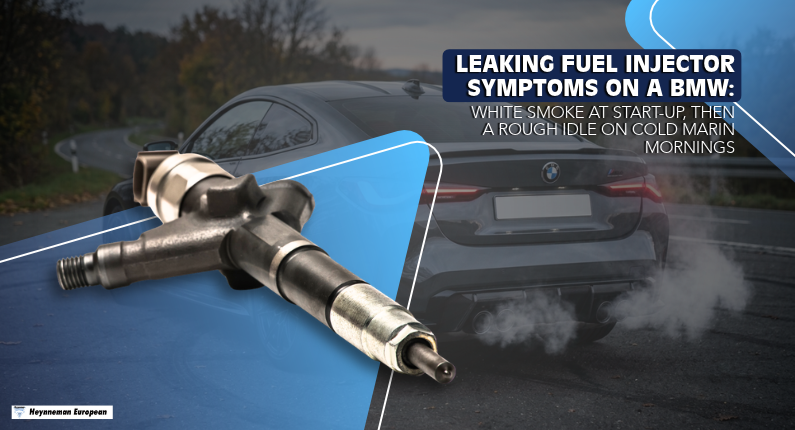
The pattern is specific. A BMW that sat overnight starts with a puff of white smoke, idles rough for the first half-minute, and then runs fine for the rest of the day. Those are classic leaking fuel injector symptoms. On a direct-injection BMW, they usually mean one injector is dripping fuel into its cylinder after the engine shuts off. Cold Marin mornings make it obvious. Trace it now, before the holiday drives up 101, because a dripping injector washes oil off a cylinder wall every night it’s left alone.
Quick Summary: Key Takeaways
- The tell is timing: smoke and roughness right after a cold start that fade once the engine warms point to an injector leaking down overnight.
- Smell the smoke: raw gasoline means fuel, a sweet smell means coolant, and thin odorless vapor is usually just condensation.
- It’s usually one injector: testing shows which cylinder is getting the extra fuel.
- Waiting costs more: fuel in the cylinder thins the oil and wears the bore, and misfires heat up the catalytic converter.
What Leaking Fuel Injector Symptoms Look Like on a Cold Start
Timing is the clue. A leaking injector shows up worst on the first start after the car has sat for hours, and it fades as the engine warms.
Expect a puff of white or grey smoke that smells of raw fuel, a shake at idle, and sometimes a longer crank before the engine catches. Then it settles. Because the car drives normally by the end of the street, a small leak can run for months.
Why a Dripping Injector Shows Up After the Car Sits
A direct-injection engine sprays fuel straight into the cylinder at very high pressure, and some of that pressure stays trapped in the fuel rail after you switch off. If an injector tip doesn’t seal, that leftover pressure pushes fuel through it. Drop by drop.
By morning there’s a small pool of gasoline sitting on top of one piston. At start-up that cylinder gets far too much fuel, so it misfires, and the unburned fuel leaves as smoke. Cold makes it worse. Western Regional Climate Center records for the San Rafael Civic Center station, kept from 1894 to 2016, show an average January low of 40.9°F, and fuel that cold vaporizes slowly, so more of it goes out the tailpipe unburned. A car parked outside in Fairfax or San Anselmo can smoke noticeably more on a frosty morning than it does in April.
White Smoke on Startup Has Three Common Causes
Not every white cloud is an injector. Smell it. Then time it.
Condensation is the harmless one: thin, odorless steam on a damp morning that vanishes once the pipes warm, often with a drip of water from the tailpipe. Fuel smoke is greyer, smells like a gas can, and clears within a minute along with the rough idle. Coolant smoke smells sweet and keeps going after warm-up while the reservoir level slowly drops, which points to a gasket or head problem instead of the fuel system. Blue-grey means oil.
A Leak Left Alone Gets Expensive
Raw fuel strips the oil film off the cylinder wall, so every cold start with a leaking injector wears that bore a little faster. Some of the fuel also slips past the rings into the crankcase, and engine oil that smells of gasoline on the dipstick is a sign it has been going on for a while. Pull the dipstick and sniff it.
Smelling fuel in the garage is different, and more urgent, because it can mean an external leak at an injector seal where gasoline is reaching a hot engine. Don’t drive it.
Misfires also send unburned fuel into the catalytic converter, where it burns and overheats the inside and, given enough cold mornings, ruins a part that costs far more than one injector. A check engine light that stays on also fails a California Smog Check.
How the Leak Gets Pinned to One Injector
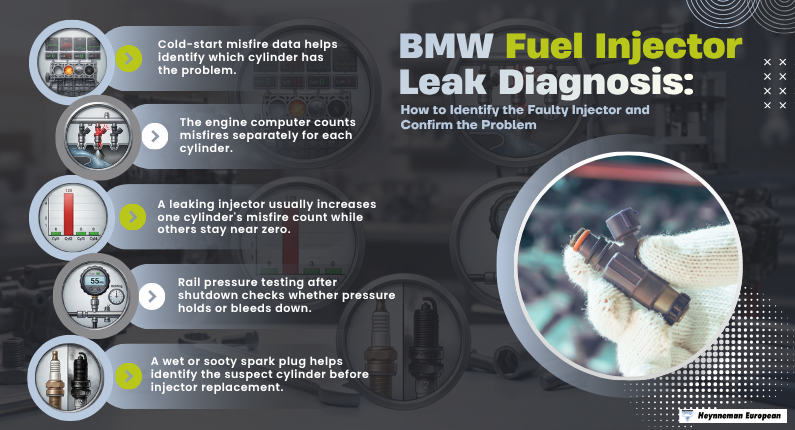
Diagnosis starts with cold-start misfire data. The engine computer counts misfires cylinder by cylinder, and a leaking injector usually lights up one cylinder’s count while the others stay near zero. Heynneman European reads it with a dedicated BMW diagnostics computer rather than a parts-store code reader.
Testing confirms it. Rail pressure can be watched after shutdown to see whether it holds or bleeds down, and a plug pulled from the suspect cylinder is often wet or sooty while its neighbors look clean. Then the faulty injector is replaced with fresh seals, and the next cold start shows whether that cylinder’s misfire count has gone quiet.
A BMW Shop on Kerner Blvd for Marin Drivers
Paul Heynneman, an alumnus of Sonnen BMW and BMW AutoZentrum, opened the shop in 1979, and he still handles diagnosis himself. That background helps with a fault that only shows up for half a minute a day.
Leave it overnight. The symptom needs a cold start, and drivers coming up 101 from Mill Valley or Corte Madera can ask about a complimentary loaner if the job runs long. Repairs carry a 24-month, 24,000-mile warranty on parts and labor.
Frequently Asked Questions
Q: What are the symptoms of a leaking fuel injector?
A: Fuel-smelling white or grey smoke at the first start of the day, a rough idle that fades as the engine warms, a longer crank, and sometimes oil that smells of gasoline.
Q: Is white smoke on startup normal?
A: Thin, odorless vapor that clears as the exhaust warms is normal condensation. Smoke that smells of fuel or sweet coolant, or keeps going after warm-up, needs checking.
Q: Can a leaking injector cause a misfire only when the engine is cold?
A: Yes. Fuel that drips into a cylinder overnight floods it at the next start, and that cylinder misfires until the excess burns off.
Start-Up Smoke Diagnosis for BMWs in San Rafael
Jot down how long the smoke lasts and which mornings it’s worst. Then use the form at heynnemaneuropean.com to say the car can stay overnight, and drive it to 3155 Kerner Blvd, San Rafael, CA 94901 for the cold-start check.
