
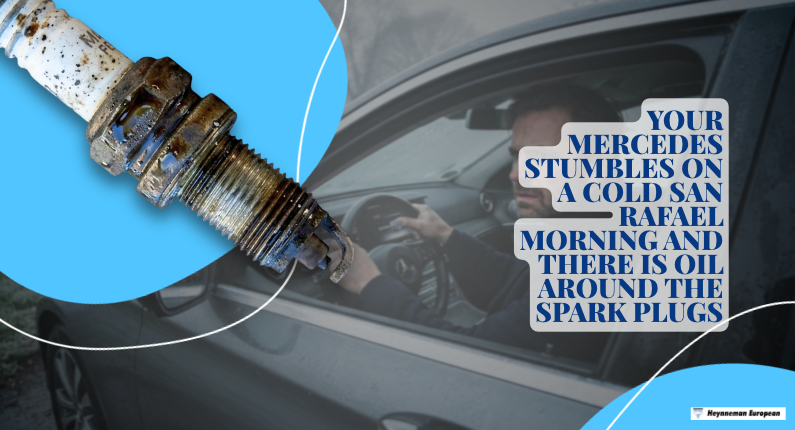
It shows up as a shake for the first half mile and a check engine light that sometimes clears itself before you get where you were going. A scanner reads a misfire on one cylinder, or two cylinders on the same bank, and the obvious move is a set of plugs and coils.
Pull the first coil and the answer is usually sitting right there: the spark plug well is half full of engine oil, the rubber boot on the coil is swollen and shiny, and the plug has been firing through a bath for months.
The seal that fails is not the valve cover gasket
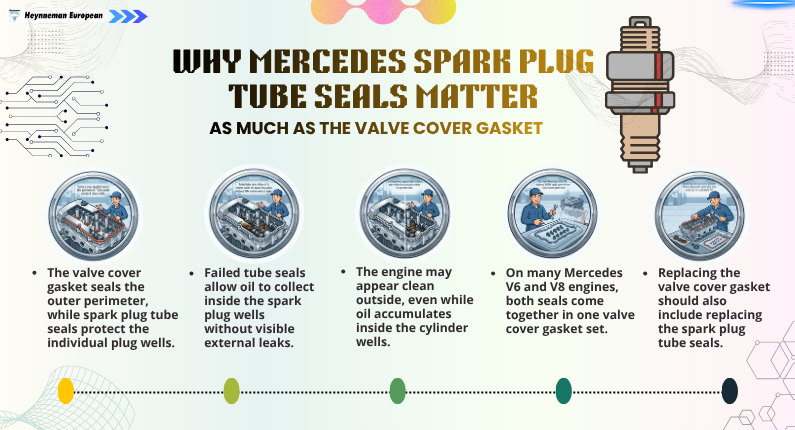
These are two different seals doing two different jobs, and that is why the repair gets mis-specified so often. A valve cover gasket runs around the outer perimeter of the cover and keeps oil from escaping to the outside of the engine. The spark plug tube seals are separate grommets, one per cylinder, sealing where the cover passes over each plug tube.
When the perimeter gasket fails, you get a wet engine and a burning smell. The tube seals failing give you no external evidence at all, because the oil runs down inside the well where nothing can escape. Outside, the engine stays clean while a cylinder slowly drowns.
On the V6 and V8 Mercedes engines we see most around Marin, both seals are usually part of one valve cover gasket set, so a shop replacing the cover gasket should be replacing the tube seals in the same operation. Ask whether they are.
What oil in the well does to the ignition system
The coil sits down in the tube with a rubber boot that has to seal against the porcelain of the plug and insulate thousands of volts from the cylinder head an inch away. Oil attacks that boot directly. Rubber swells, loses its grip on the plug, and develops a path for the spark to track sideways to ground instead of jumping the electrode.
Most of the time the misfire is exactly that. Your plug is fine and the coil is often fine too, electrically. The spark is simply taking an easier route through an oil-soaked boot.
Left running, it stops being cheap. A misfiring cylinder dumps unburned fuel into the exhaust, and raw fuel hitting a hot catalytic converter is one of the quickest ways to destroy one. So a flashing check engine light deserves a faster response than a steady one.
The light itself has consequences in California
There is a scheduling reason to deal with this now. The Bureau of Automotive Repair’s inspection standards are unambiguous: a vehicle fails the OBD portion of a Smog Check when the malfunction indicator lamp is illuminated with the engine running. An intermittent misfire that lights the dash is a failed inspection whenever the light happens to be on that day.
Clearing the code before you go does not help either, because the readiness monitors reset with it and an unprepared car fails on that instead.
Why cold, wet Marin mornings bring it out
Two things conspire in December. Cold oil is thicker and drains more slowly off the top of the head overnight, so there is more of it sitting against the tube seals by morning than there would be in August. And a cold start demands the strongest spark of the day, because the mixture is rich and the cylinder is cold.
So you get the hardest ignition conditions of the day at the moment the well is fullest, and that is exactly why the shake is at its worst leaving the driveway and gone by the time the engine is warm. Owners often decide the problem fixed itself. It is just hiding until the next morning.
What a proper repair involves
The coils come out, the wells get drained and cleaned, and the plugs get replaced because a plug that has been sitting in oil is finished regardless of how it looks. Any coil with a swollen or hardened boot gets replaced too, and that decision should be made by looking at the boots, not by replacing all of them automatically.
Then the valve cover comes off, the perimeter gasket and all the tube seals are renewed, and the sealing faces get cleaned properly. On engines where the cover itself has warped or the camshaft position sensor sits in the cover, those get checked while everything is apart. Figure on a few hours of work that ends the problem. A third set of coils will not.
Frequently Asked Questions
Q: Can I just replace the coil in the cylinder that is misfiring?
A: You can, and the new coil will sit in the same oil. Expect it back within a few months unless the seals are replaced.
Q: Will oil in the spark plug well damage the engine itself?
A: The engine itself is not at risk. Damage runs toward the coils, the plugs and the catalytic converter, and that last one is the expensive part.
We Will Open the Wells and Show You What Is in Them
One coil out and a light down the tube settles this in a few minutes. You see what is sitting in there before a single part gets recommended.
Heynneman European — 3155 Kerner Blvd, San Rafael, CA 94901
