
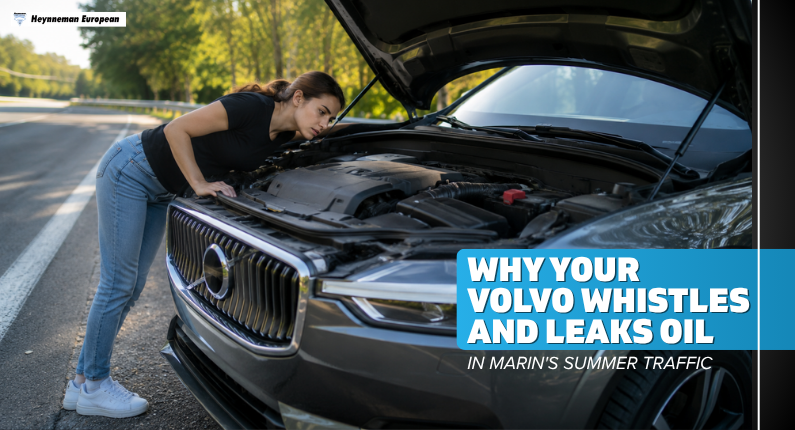
You pop the hood after a slow crawl down 101 and hear it — a faint whistle from the engine. Maybe the oil cap fights you when you twist it, or a fresh oil spot has shown up on the driveway in Larkspur.
Those are classic signs of a failing Volvo PCV system. The crankcase ventilation traps oil and vents pressure, and when it clogs in summer heat and stop-and-go traffic, that pressure has to go somewhere — usually past a seal. Left alone, a cheap breather fix turns into leaking gaskets and a smoking tailpipe. So get it checked before it pushes out the rear main seal.
Quick Summary: Key Takeaways
- Listen for the whistle: A whistling or hissing engine and a stiff oil cap point straight at PCV pressure.
- It’s a breather, not a mystery: The PCV oil trap clogs with sludge and fails, especially on higher-mileage Volvos.
- Heat and traffic clog it faster: Summer idling on 101 keeps the oil hot and the vapors flowing, choking the system.
- Pressure finds the weakest seal: Ignored PCV problems blow out valve-cover and rear main seals, turning a $200 job into a $1,500 one.
- We test the pressure: A crankcase pressure check confirms the fault before we replace any parts.
How a Failing Volvo PCV System Shows Itself
The clearest tells are a whistle and oil where it should not be. When the PCV oil trap clogs, crankcase pressure builds, and you may hear a steady whistle or hiss from the engine at idle. Try the oil cap. If it is hard to twist off, or the dipstick pops up on its own, pressure is running high inside the block and the system can no longer breathe the way it was designed to.
From there you get oil leaks at the valve cover or rear main, a rough idle, and sometimes a check engine light for a lean condition. None of it fixes itself.
What the PCV System Does and Why Volvos Clog It
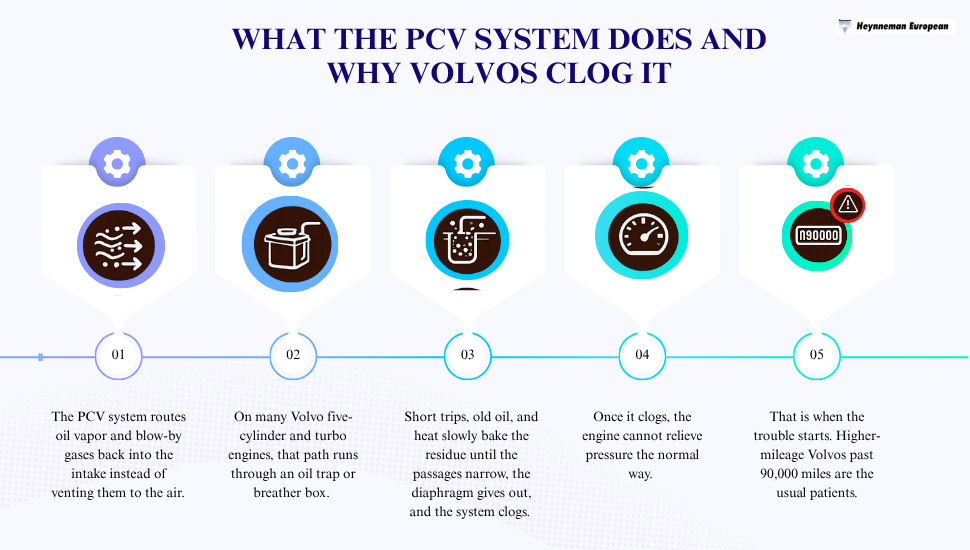
The PCV system routes oil vapor and blow-by gases back into the intake instead of venting them to the air. On many Volvo five-cylinder and turbo engines, that path runs through an oil trap or breather box, and short trips, old oil, and heat slowly bake the residue until the passages narrow and the diaphragm gives out. Then it clogs.
Once it does, the engine cannot relieve pressure the normal way. That is when the trouble starts. Higher-mileage Volvos past 90,000 miles are the usual patients.
Marin’s Stop-and-Go Summer Commute Makes It Worse
Heat and idling are exactly what a marginal PCV system hates. Crawling 101 through San Rafael or sitting in the Larkspur ferry backup on a July afternoon keeps the oil hot and the crankcase vapors flowing, with almost no airflow to help, and warm oil thins and produces more blow-by than a clogged trap can ever handle.
AAA expected to rescue 7.7 million drivers over the summer of 2025, and heat-driven engine problems make up a big share of those calls. A Volvo building crankcase pressure in traffic is a slow-motion version of that. Catch it early.
Ignoring PCV Pressure Pushes Out Seals and Gaskets
Crankcase pressure always finds the weakest seal, and on a Volvo that gets expensive. A clogged PCV can force oil past the valve-cover gasket, the cam seals, or the rear main seal behind the transmission. A breather or oil-trap repair is often $200 to $500. Timing is everything.
Wait until that pressure blows the rear main, though, and you are paying to pull the transmission at $1,200 to $1,800 or more, on a job that started as a simple breather. The cheap fix and the expensive one are the same problem, caught at different times. Fix it while it is still the cheap one.
How We Test and Rebuild a Volvo PCV System
We measure crankcase pressure before we replace anything. No guesswork. A simple gauge on the oil-fill or dipstick tube tells us whether the system is venting properly or choked, so we are not throwing parts at it, and if the trap or breather is clogged, we replace it with the correct Volvo components and check every hose for collapse.
Then we confirm the pressure reads normal and hunt down any seal the old pressure already damaged. Most PCV service is a same-day job. You leave knowing the root cause is handled, not just the symptom.

Why Marin Volvo Owners Trust Heynneman
Paul Heynneman opened this shop in 1979, and he still writes service and runs diagnostics himself. Drivers from Corte Madera, Fairfax, Kentfield, and Mill Valley bring us their Volvos because we know these cars cold, and every qualifying job carries a 24-month, 24,000-mile nationwide warranty from an ASE-certified, AAA-approved shop.
Loaner cars are on us. We diagnose before we replace, and we do not sell work you do not need. That has held for over 40 years.
Frequently Asked Questions
Q: What are the signs of a bad PCV system on a Volvo?
A: A whistling or hissing engine at idle, an oil cap that is hard to remove, oil leaks at the valve cover or rear main, a rough idle, and sometimes a check engine light. If you notice a whistle plus fresh oil spots, have the crankcase pressure tested before seals start letting go.
Q: Can a clogged PCV cause oil leaks?
A: Yes, and that is the expensive part. When the PCV clogs, crankcase pressure builds and forces oil past the nearest seal, often the valve-cover gasket or the rear main seal. Fixing the PCV early keeps that pressure from turning into a much larger repair.
Q: How often does a Volvo PCV system need service?
A: There is no fixed interval, but higher-mileage Volvos past 90,000 miles and cars driven on short, hot trips clog sooner. If you are seeing any pressure symptoms, get it tested. Fresh oil at the right interval also slows the sludge that clogs the system.
Get Your Volvo’s PCV System Checked in San Rafael
Hearing a whistle or finding oil in the driveway? Bring your Volvo in before the pressure costs you a seal.
Heynneman European — 3155 Kerner Blvd, San Rafael, CA 94901
Hours: Monday–Friday, 8:00 AM – 5:00 PM
Website: heynnemaneuropean.com
