
Quick Takeaways:
- The crankshaft position sensor tells the ECU where the crankshaft is in its rotation — without an accurate signal, fuel injection and ignition cannot be timed correctly.
- A failing crankshaft sensor causes intermittent stalling, no-start conditions after hot soaks, and rough running that can appear and disappear without warning.
- Crankshaft sensor failure is notoriously intermittent — symptoms often do not produce stored fault codes when the vehicle restarts normally.
- Heat is the primary failure trigger — many San Rafael Mercedes owners experience stalling after the engine is fully warm, not during cold starts.
- Heynneman European in San Rafael uses Mercedes-specific diagnostic tools to capture intermittent crankshaft sensor faults that generic scanners miss.
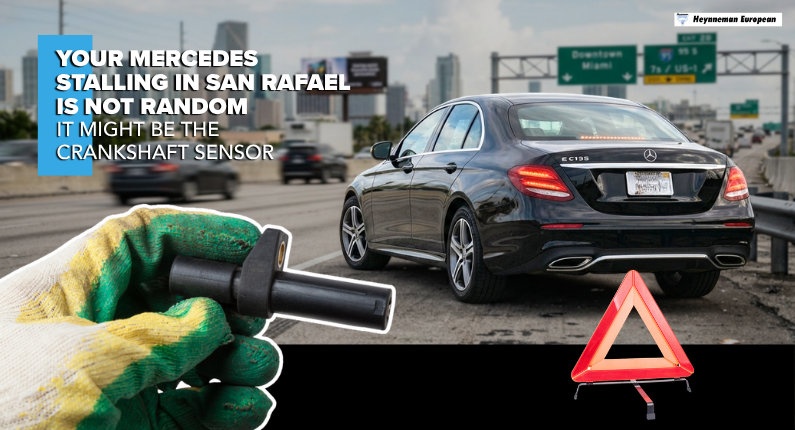
Marin County driving has a specific character that makes an intermittent stalling problem particularly inconvenient. The mix of highway driving on US-101, the Sir Francis Drake corridor in San Rafael, and the occasional mountain road over to Fairfax means that stalling events rarely happen in convenient locations. Mercedes owners who have experienced their car stalling at a light on Fourth Street, restarting normally, and then being told by a shop that ‘no fault codes were found‘ have typically encountered the crankshaft position sensor failure mode that produces no stored evidence when the vehicle recovers. Heynneman European in San Rafael specializes in Mercedes service and has the diagnostic approach to capture intermittent CKP sensor faults that leave generic scanning results empty.
What does the Mercedes crankshaft position sensor do, and why does its failure cause stalling?
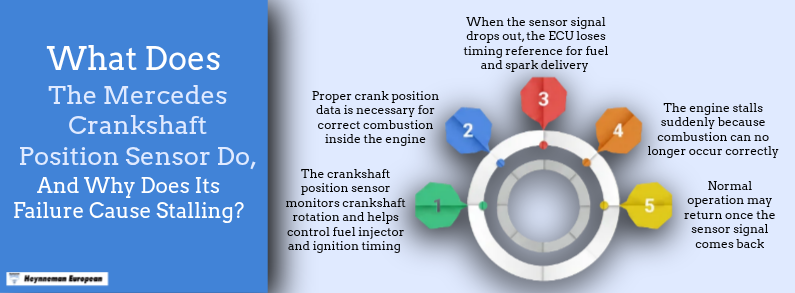
The crankshaft position sensor monitors a toothed reluctor ring on the crankshaft, detecting the precise rotational position of the crank at any given moment. The engine control module uses this data to calculate when to fire each fuel injector and when to trigger the ignition coil for each cylinder. The timing of these events relative to crank position determines whether combustion happens correctly.
When the sensor drops out — even briefly — the ECU loses the crank position reference it needs to time fuel and spark delivery. The engine stalls because it literally does not know when to fire the injectors. This is why the stall can be so sudden: one moment the engine is running normally, the next the CKP signal is gone and combustion stops. A few seconds later, as the sensor cools slightly or the engine restarts and the signal returns, normal operation resumes with no stored evidence of the event. Schedule a Mercedes diagnostic appointment at Heynneman European in San Rafael.
Why does crankshaft sensor failure behave differently than most Mercedes faults?
Most automotive fault codes are stored when the ECU detects a value outside its acceptable range, and that condition persists long enough to confirm the fault rather than dismiss it as a transient reading. The crankshaft sensor failure that causes stalling is often a brief dropout — the signal is present, drops for a fraction of a second, causing a stall, and returns before the ECU’s fault detection logic has decided whether to store a code.
The result is a fault that causes a real and sometimes dangerous symptom without leaving diagnostic evidence. This is one of the most frustrating scenarios for drivers who bring the car in after a stalling event and are told everything looks fine. Heynneman European uses Mercedes XENTRY/DAS to monitor crankshaft signal waveform in real time during a test drive, looking for the brief dropout pattern that standard fault code scanning does not reveal.
What other symptoms accompany crankshaft position sensor failure on a Mercedes?
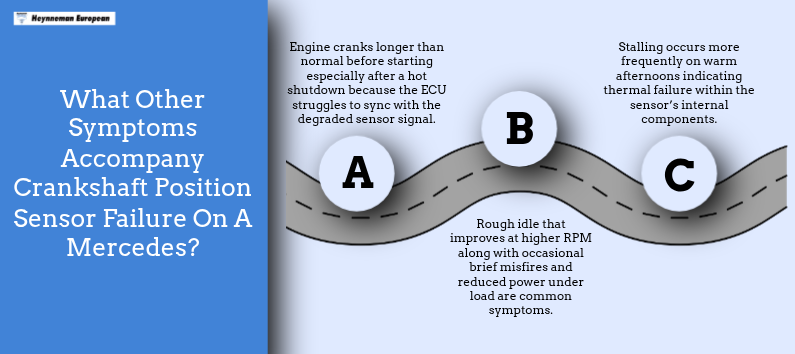
Beyond stalling, drivers may notice the engine cranking for longer than normal before firing — particularly after a hot shutdown and then an immediate restart attempt. This extended crank time occurs because the ECU takes longer to establish sync with a sensor that has degraded signal quality.
Rough running at idle that improves as RPM increases, occasional brief misfires that do not produce consistent codes, and a reduction in power under load are also associated with intermittent CKP sensor issues. Some Mercedes owners report that the stalling happens most reliably on warm afternoons in Marin — this heat correlation is a strong indicator of thermal failure in the sensor’s internal components. Get expert San Rafael Mercedes repair today.
What does crankshaft sensor replacement involve on a Mercedes?
On most Mercedes models, the crankshaft position sensor is located on the engine block near the starter motor or oil pan area. Access varies by model but is generally manageable without major engine disassembly — the sensor is typically retained by one or two bolts and its connector is nearby.
Following sensor replacement, the Mercedes ECU may require a crankshaft sensor adaptation or relearn procedure depending on the model. This procedure is performed using XENTRY and confirms the new sensor’s signal quality meets specification before the vehicle is returned to service. Heynneman European performs this step as part of the standard replacement procedure.
Frequently Asked Questions
Q: How does Heynneman European capture an intermittent crankshaft sensor fault?
A: The most reliable method is a real-time waveform capture of the crankshaft sensor signal during a test drive under conditions that match when the stalling occurs. XENTRY allows signal waveform monitoring that shows brief dropouts even when they are too short to store a fault code. Providing specific information about when the stalling happens helps target the test drive conditions.
Q: Is crankshaft sensor replacement expensive on a Mercedes?
A: The sensor itself is a relatively inexpensive component. The labor varies by model depending on sensor access. Contact Heynneman European for a specific estimate for your model and year after confirming the diagnosis.
Q: Can a crankshaft sensor failure strand me on the road?
A: Yes — in more advanced failure, the sensor dropout becomes frequent enough that the engine cannot run reliably. The vehicle may stall repeatedly and not restart until the engine cools and the sensor partially recovers. This is the stage at which the failure creates a genuine safety and reliability concern.
Q: Does Heynneman European service other European brands besides Mercedes?
A: Yes — Heynneman European services BMW, Audi, Porsche, Volvo, and other European brands alongside Mercedes in the San Rafael and Marin County area. Contact the shop to confirm service availability for your vehicle.
